An In-Depth Look at Deep Hole Drilling: Technologies, Challenges, and Solutions
In modern manufacturing, deep hole drilling is a critically important and highly challenging specialized technology. It is widely used in fields such as aerospace, the automotive industry, energy equipment, and mold manufacturing. Unlike conventional hole machining, deep hole drilling places extremely high demands on machine tools, cutting tools, cooling systems, and programming due to its unique process characteristics.
I. What is Deep Hole Drilling?
Deep hole drilling typically refers to the process of machining holes where the ratio of depth to diameter (L/D, known as the aspect ratio) is greater than or equal to 5. When the aspect ratio exceeds 10, it is considered typical deep hole drilling, with some extreme applications reaching aspect ratios of over 1000.
Core Characteristics:
Large Aspect Ratio: This is the most fundamental characteristic.
High Machining Difficulty: Tools are long and slender, with poor rigidity, making them prone to deviation and vibration.
Difficult Chip Evacuation: Chips are difficult to remove from the narrow hole, easily causing clogging and tool damage.
Poor Heat Dissipation:Heat is concentrated in the cutting zone, and coolant has difficulty effectively reaching the cutting edge.
Zero Visibility:Operators cannot directly observe the machining process and rely on sound, parameters, and monitoring systems for judgment.
II. Major Challenges in Deep Hole Drilling
Hole Deviation: Due to the large tool aspect ratio and insufficient rigidity, the tool easily "deviates" when entering the workpiece, leading to deviations in hole position and straightness.
Poor Chip Evacuation: Chip breaking and evacuation are the soul of deep hole drilling. Continuous stringy chips can wrap around the tool holder, clog the hole, scratch the finished surface, and even cause the tool holder to break.
Tool Wear and Heat Dissipation: Cutting heat is concentrated at the drill tip. With insufficient cooling, the tool wears rapidly, affecting machining accuracy and tool life.
Surface Quality and Accuracy: Vibration and poor chip evacuation lead to poor hole wall surface quality, including chatter marks and scratches, making it difficult to guarantee dimensional accuracy and cylindricity.
III. Key Technologies and Solutions
To address the above challenges, a series of specialized technologies and processes have been developed for deep hole drilling.
1. Core Machining Methods:
Gun Drilling Technology:
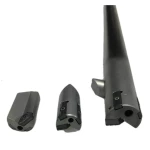
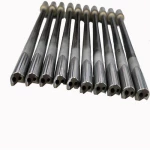
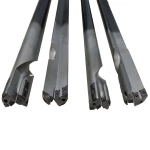
Principle: A single-point cutting tool with an internal high-pressure coolant channel. Coolant travels internally through the tool holder directly to the cutting edge, providing cooling and lubrication, and then carries chips out through the external V-shaped flute.
Characteristics: Capable of machining deep holes with aspect ratios of 100-300 in a single pass, with high precision and good straightness. It is the most efficient method for machining small diameter (typically φ1mm - φ30mm) deep holes.
Application: Small diameter deep holes in batch production. (D1-30mm, maximum total length up to 4000mm).


BTA / Ejector Drilling Technology:
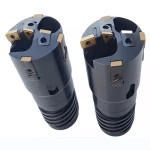
Principle: A multi-point cutting tool using inner and outer tube structures. High-pressure coolant enters through the gap between the inner and outer tubes, flushes the cutting zone, carries chips, and is forcibly discharged through the inner tube.
Characteristics: Larger chip evacuation space, significantly more efficient than gun drilling, suitable for larger diameter (typically φ20mm and above) deep hole machining.
Application:High-efficiency mass production of medium and large diameter deep holes.

 Trepanning (Annular Cutting) Technology:
Principle: The tool acts like an annular cutter, machining only the periphery of the hole and leaving a solid core in the center.
Characteristics: Lower material removal rate, even force distribution, minimal vibration, extremely high machining accuracy and straightness, and material saving.
Application: Large diameter (typically φ65mm and above) ultra-high precision deep holes, such as generator rotor center holes.

2. Indispensable Auxiliary Systems:
High-Pressure Coolant System:The "lifeline" of deep hole drilling. It not only cools the tool but, more importantly, "pushes" or "blows" chips out from the bottom of the hole. Pressure typically needs to reach 50-200 bar or even higher.
Professional Chip Breaking Technology: Long chips are segmented into small pieces for easy evacuation through programmed "peck drilling" (intermittent feed) or the tool's own chip breaker design.
Tools and Tool Holders:Use rigid carbide materials and incorporate vibration damping designs (e.g., carbide bushings, dampened tool holders) to suppress vibration.
IV. Best Practices for Successful Deep Hole Drilling
Before Drilling:
Workpiece Preparation: Ensure the entry face is flat. It is best to pre-drill a center hole or use a guide bushing to prevent drill deviation.
Tool Selection: Select the most suitable tool and method based on the material, hole diameter, and depth.
Parameter Setting: Follow the tool manufacturer's recommendations to set appropriate speed, feed, and coolant pressure.
During Drilling:
Stable Feed: Maintain a constant and appropriate feed rate. Avoid pauses, as they can exacerbate tool wear and degrade surface quality.
Monitor and Listen: Closely watch the machine load, sound, and vibration. Any abnormality may indicate poor chip evacuation or tool breakage.
Regular Retraction (Peck Drilling): For drills without forced chip evacuation, periodic retraction helps break and remove chips.
After Drilling:
Cleaning:After machining is complete, be sure to clean residual chips and coolant from the hole.
V. Application Fields
Aerospace: Engine blade cooling holes, landing gear actuators, fuel injectors.
Automotive Industry: Camshafts, crankshafts, transmission shafts, oil gallery holes in hydraulic cylinder blocks.
Energy Equipment: Steam turbine rotor center holes, boiler tube sheets, nuclear power components.
Mold Manufacturing: Hot runner and cooling channels in injection molds and die-casting molds.
Medical Devices:Orthopedic surgical instruments, endoscope components.
Conclusion
Deep hole drilling has evolved from an "art" into a mature "science." It is no longer simple drilling but a systems engineering discipline integrating machine tool dynamics, metal cutting theory, fluid mechanics, and materials science. By selecting the appropriate machining method, equipping with high-performance tools and cooling systems, and following strict process procedures, manufacturers can efficiently and precisely conquer the challenges of depth, providing crucial support for the manufacturing of high-end equipment.
We hope this article helps you fully understand deep hole drilling. If you are interested in a specific aspect (such as detailed gun drilling parameters or programming techniques), we can continue to explore further.
Lily KBD